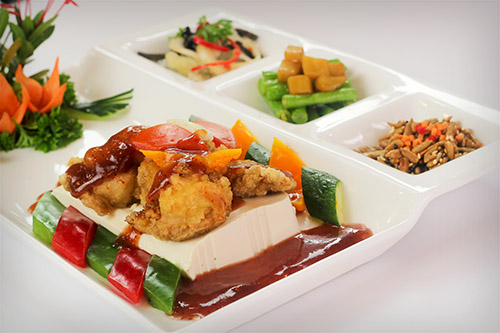
Fried breaded monkey head mushroom on a bed of tofu topped with homemade sweet and sour cranberry sauce.
As Chinese dishes go, there are several that flex their muscles, standing out globally to serve as tasty bastions of the nation, such as Kung Pao chicken, Peking duck, spring rolls, and, of course, that king of American-Chinese cuisine, sweet and sour pork (咕噜肉)—these food megastars each have their attendant mistresses. One such dish is, the ever-tarty, sweet and sour mushrooms (咕噜菇).
Sweet and sour mushrooms, as one might guess, attained its English name due to its distinctive tangy taste. The sweet and sour sauce (糖醋酱) is a combination popular throughout numerous regional Chinese cuisines. Traditionally, the sweet and sour dish uses pork tenderloin as its main ingredient, coupled with green and red bell peppers, as well as onions and pineapple. The sauce provides flavor for the pork, its sharpness seeping into the meat itself, as well as the crispy fl our shell. By substituting meat with a vegetarian choice, in this case mushrooms, we end up with a vegetarian sweet and sour dish that still packs a mean punch flavor wise.
The name for “sweet and sour” dishes in Chinese, or gulao (咕噜), is more interesting than its English counterpart and somewhat puzzling as well. Gulao is a gulping sound; there are multiple theories as to why a dish is named after an onomatopoeia. One is that the sweet and sour flavor is so mouthwateringly enticing that whoever smells it instantly has to swallow at the mere thought of the tangy juices in their mouth. Another theory contends that “gulaorou” derives from “gu lao rou” (古老肉, literally ancient meat).
 Medifoods